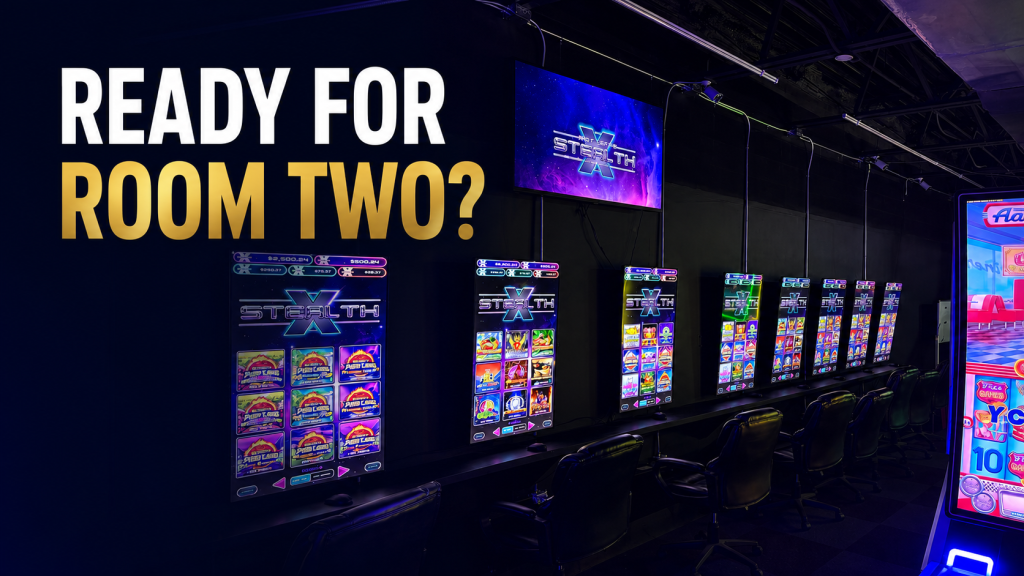
Growth is exciting, opening a second game room can also become expensive very quickly when it happens before a business is ready.
For game room operators and businesses using gaming as an additional revenue stream, expansion doesn’t necessarily mean building a massive new location. It could mean opening a second game room, adding gaming to another existing business, expanding the gaming area at a successful location, or introducing equipment into additional stores within a company’s portfolio.
The important question isn’t simply, “Can we expand?”
It’s “Have we built something that can be repeated successfully?”
Before committing to another location, consider these eight signs.
1. Your Current Location Has Consistent Performance
A few exceptional weeks shouldn’t determine whether you expand.
Look for consistency.
Operators should understand how their location performs across different weeks, months, seasons, and customer traffic patterns.
You should be able to answer questions such as:
- What does a typical week look like?
- Which periods are consistently strongest?
- Which periods are slower?
- Which equipment performs consistently?
- How much does performance fluctuate?
Expansion decisions of opening a second game room become much stronger when they’re based on patterns rather than one unusually successful period.
2. You’ve Outgrown Your Current Space
Sometimes your customers tell you it’s time to expand without saying a word.
You may notice customers waiting for equipment, crowded walkways, limited seating, or certain periods when your existing gaming area feels noticeably undersized.
That doesn’t automatically mean you need another building.
Your first option may be reorganizing the current floor.
A professional layout evaluation can sometimes reveal opportunities to increase capacity while maintaining comfortable walkways and a clean customer experience.
If you’ve already optimized the existing space and demand continues to exceed capacity, expansion becomes much more compelling.
3. Customers Are Asking for Another Location
Pay attention when customers repeatedly ask:
“ When are you opening a second game room?”
That question can be valuable market research.
If customers are traveling considerable distances to visit your business—or repeatedly requesting a location in another part of town—you may have an opportunity worth investigating.
Before choosing a site, evaluate the surrounding market carefully. Customer demographics, traffic patterns, nearby businesses, parking, visibility, operating costs, and applicable local requirements can all influence whether a location makes sense.
4. Your Current Location Can Operate Without You
This may be the most important test.
If the business falls apart whenever the owner leaves, adding another location usually multiplies the problem.
Before opening a second game room, your existing operation should have documented procedures covering areas such as:
- Opening and closing
- Cash handling and reconciliation
- Equipment issue reporting
- Customer service
- Cleaning
- Employee responsibilities
- Shift changes
- Security procedures
- Management reporting
A second location requires systems—not just more employees.
The goal is to create an operation that produces consistent standards regardless of which manager happens to be working.
5. Your Reporting Is Organized
Multi-location businesses need visibility.
Operators should be able to review important information without physically visiting every location.
Good reporting can help management compare performance, identify unusual changes, evaluate equipment, and spot operational issues before they become larger problems.
As you expand, standardized reporting becomes increasingly important.
If Location A tracks information differently from Location B, comparing the two becomes unnecessarily difficult.
Building standardized reporting before expansion can save considerable time later.
6. You Have Reliable Technical Support
One location experiencing an equipment problem is inconvenient.
Several locations experiencing problems simultaneously can become an operational headache.
Before expanding, make sure you have a clear process for technical support.
You should know:
- Who employees contact when equipment has an issue.
- How service requests are documented.
- How quickly problems are typically addressed.
- Who determines whether equipment needs repair or replacement.
- How recurring issues are tracked.
Technical support becomes increasingly important as your footprint grows.
A reliable gaming partner can help operators avoid having ownership become the first phone call for every equipment problem.
7. You’ve Found Another Location That Actually Fits
Never expand simply because commercial space becomes available.
A lower lease doesn’t automatically make a location attractive.
Consider the complete picture:
Visibility: Can customers easily see and find the business?
Parking: Is access convenient?
Traffic: Does the surrounding area produce the right type of customer activity?
Space: Can the equipment be arranged comfortably?
Infrastructure: Does the property have appropriate electrical and connectivity capabilities?
Security: Can the location be properly monitored?
Operating expenses: Will rent, payroll, utilities, insurance, maintenance, and other costs leave enough room for the business to perform?
And importantly, verify the applicable licensing, zoning, regulatory, and other legal requirements before committing to a property or installing equipment.
8. You Have the Right Partners to Scale With You
The vendors that work for one location may not necessarily be equipped to support five.
As you expand, reliability becomes increasingly important.
Your gaming solutions provider should be capable of supporting multiple locations with consistent installation standards, service, communication, and equipment management.
Ask potential partners:
- Can you support multiple locations?
- How are service requests handled?
- Can you help evaluate potential locations?
- How do you determine the appropriate equipment mix?
- Can equipment be adjusted based on performance?
- How will communication work as we grow?
A strong partner should make expansion easier to manage—not add another layer of complexity.
⸻
Expansion Should Be a Replication Strategy
One of the biggest mistakes operators can make is thinking:
“The first location makes money, so let’s open another one.”
A better approach is:
“We’ve developed a reliable operating model. Now let’s determine whether we can reproduce it.”
That’s a significant difference.
Your second location shouldn’t require reinventing your business.
The procedures, reporting systems, service standards, training, equipment strategy, and customer experience that made your first location successful should provide the foundation for the next one.
Then you improve the model each time you expand.
Start With the Numbers
Before signing another lease, create a realistic projection.
Consider startup expenses, equipment needs, payroll, rent, utilities, insurance, marketing, maintenance, security, and working capital.
Then evaluate several scenarios rather than relying on the most optimistic projection.
What happens if the new location performs strongly?
What happens if it performs at an average level?
More importantly:
What happens if it takes considerably longer than expected to become established?
A business that can survive the conservative scenario is generally in a much stronger position than one that only works when everything goes perfectly.
⸻
Scale Smarter With Barracuda Gaming
Expansion can create significant opportunities, but successful growth requires more than simply adding machines.
Barracuda Gaming works with operators and business owners to develop gaming solutions designed around their locations, operations, and growth plans.
From evaluating available space and selecting equipment to professional installation, ongoing service, and multi-location support, our team can help simplify the gaming side of expansion.
Whether you’re improving your first location or preparing for your next one, the goal is the same:
Build an operation that can grow without sacrificing the customer experience that made it successful.
We install. We manage. You earn.